

MATERIALS WE EMBRACE
MATERIALS & PROCESS
Every piece of jewelry begins with a simple intention —
to create something beautiful with care, patience, and respect for the materials that shape it.
At GEETIKAGULIA, our jewelry is not mass-produced. It is slowly crafted by hand using techniques rooted in textile artistry, where thread, texture, and colour come together to form sculptural adornments.
The result is jewelry that feels soft yet bold, delicate yet expressive — a meeting point of craftsmanship and imagination.
CRAFT THAT CANNOT BE HURRIED
We work with an ancient textile technique that most of the world uses only to make carpets or rugs. We brought it to jewelry — and in doing so, created something entirely our own.

Hand Tufting
The Art of Building Texture, One Loop at a Time
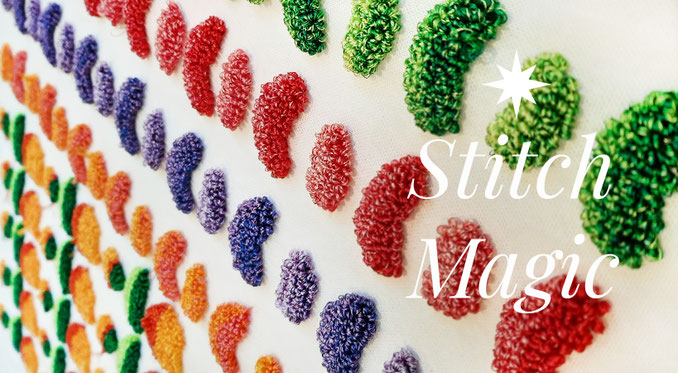
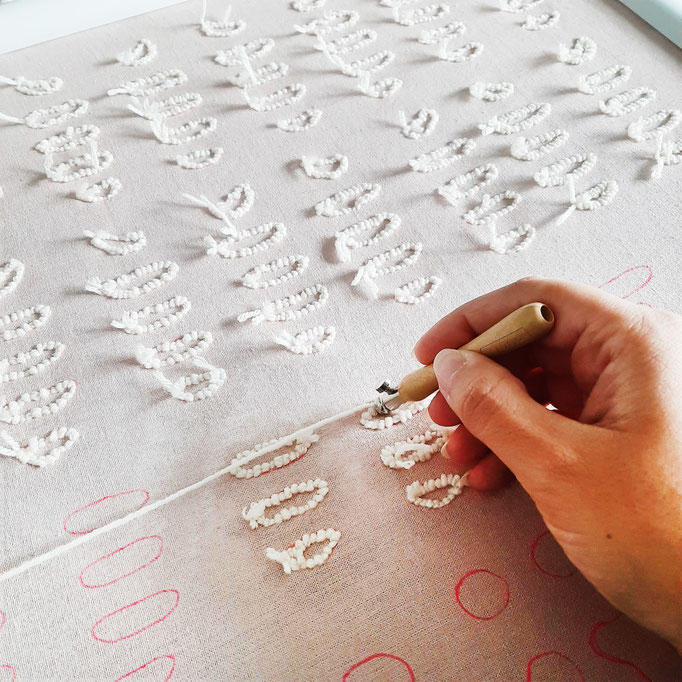
Tufting is the art of pushing yarn through a backing material to create dense, dimensional texture. In our hands, it becomes something far more delicate than its industrial origins suggest.
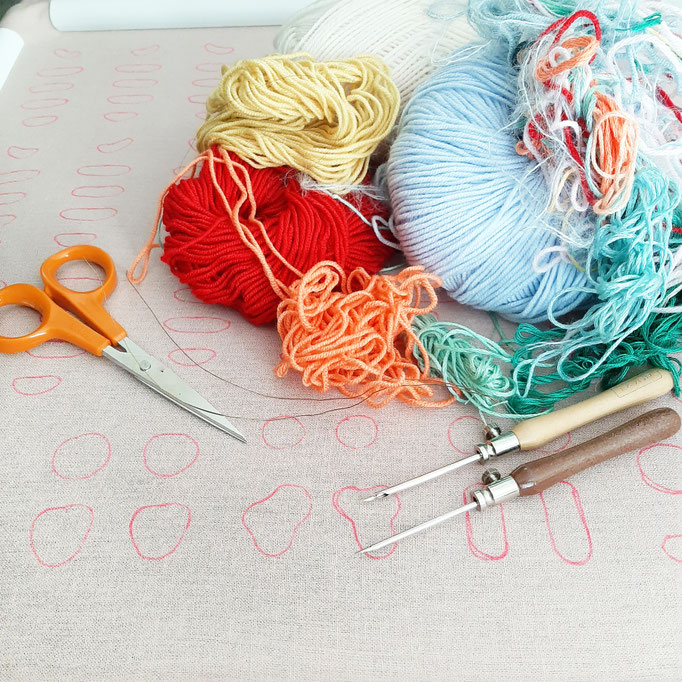
We tuft exclusively with the finest yarns — silk, alpaca wool, and other lightweight fibres — using thin, precise needles that allow us to work at a scale most tufters never attempt. Where traditional tufting creates rugs and wall hangings, we are working in centimetres. Every loop is placed with surgical intention. Each fibre cluster is considered for its weight and feel.
The result is a texture you can see from across a room and feel with your fingertips up close. Each tufted piece takes hours to complete. There is no faster way to do it well. We have never looked for one.


Hand Embroidery
The Language of the Needle
Embroidery is one of humanity's oldest forms of expression. For thousands of years, across every culture on earth, people have used needle and thread to say what words could not.
Combined with tufting, hand embroidery allows us to create pieces with an extraordinary range — from soft, plush surfaces to fine linear detail, sometimes within the same earring. This is not a process that scales. It is a practice that deepens.

THE MATERIALS
CHOSEN FOR BEAUTY. CHOSEN FOR RESPONSIBILITY
We believe the most beautiful materials are the ones that already exist. Before we ever consider buying something new, we ask: What has already been made that deserves a second life?
This question shapes every material decision we make.
THE YARnS
SILK — luminous, lightweight, and ancient. Silk catches light in a way no synthetic fibre can replicate. We use silk yarns from deadstock and waste sources, usually from the sari industry in India, honouring the extraordinary effort that goes into producing this fibre while giving surplus stock a purpose it has always deserved.
ALPACA— impossibly soft, naturally hypoallergenic, and warmer than wool by weight. Alpaca yarn brings a cloud-like quality to tufted pieces — dense but never heavy. Ours comes from recycling centres in Finland.
WOOL & MOHAIR — rich in texture and depth, they add body and lustre to our embroidered pieces. Mohair, in particular, has a halo of fibre that catches the light beautifully, giving pieces a softness that feels almost alive.
COTTON — clean, matte, and grounding. Cotton provides contrast against silkier fibres and is essential for pieces where structure and definition matter more than sheen.
INDIAN ZARI - we also use Indian zari, which is either a cotton or silk yarn wrapped in Real gold or silver. Used only for royalty in ancient times, we use it to add an extra ethereal, luxurious look to our designs.
Every single yarn we use is either waste, recycled, or industrial deadstock — fibres that existed already, waiting to become something worth keeping.
The Backing
The foundation of every GEETIKAGULIA piece — the material onto which we tuft and embroider — is made from waste fabric. Offcuts, surplus, the forgotten ends of production runs that would otherwise go nowhere. It will never be seen once the piece is finished. But we know it is there. And that matters to us.
Recycled Plastic Sequins
For our lighter earring designs, we use sequins made from recycled plastic. They bring the shimmer and playfulness for which sequins are beloved, without increasing demand for virgin plastic production.

The Beads
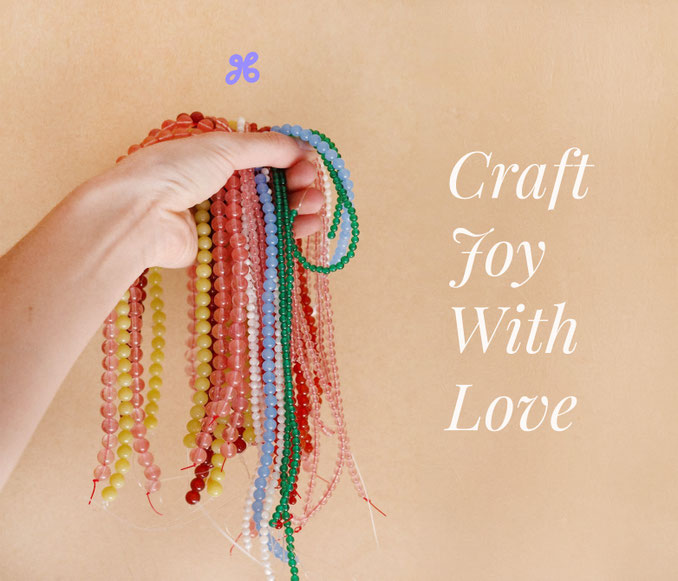
Recycled Glass Beads from Indian Bangle Factories — one of our most beloved materials, and one with a story worth telling. The glass bangle industry in India produces extraordinary quantities of surplus and broken glass. We source from these factories, transforming what would be discarded into beads of remarkable colour and character. Handmade Beads from Around the World — we source artisan-made beads from glassmakers and craftspeople across the globe:
MURANO, ITALY — home to over a thousand years of glass-blowing tradition. Murano beads carry an extraordinary depth of colour and craftsmanship that is immediately visible.
JAPAN — Japanese beads are renowned for their precision and uniformity, enabling intricate beadwork of exceptional fineness.
THAILAND — richly coloured and intricately patterned, Thai beads bring warmth and a distinct handmade character to our pieces.
INDIA — from delicate seed beads to bold statement pieces, Indian beads connect our jewelry to one of the world's oldest and most diverse craft traditions.
Acrylic Beads
Lightweight and vibrant, acrylic beads allow us to create bold, colourful earrings that are comfortable to wear all day. Weight matters in earrings — and we never forget it.

THE FINDINGS
Every clasp, hook, and connector — what jewelers call the findings — is made from silver-plated brass and is entirely nickel-free.
We chose nickel-free findings deliberately. Nickel allergies are among the most common contact allergies in the world, disproportionately affecting women. Our jewelry is made to be worn with joy, not discomfort. This was never a compromise we were willing to make.


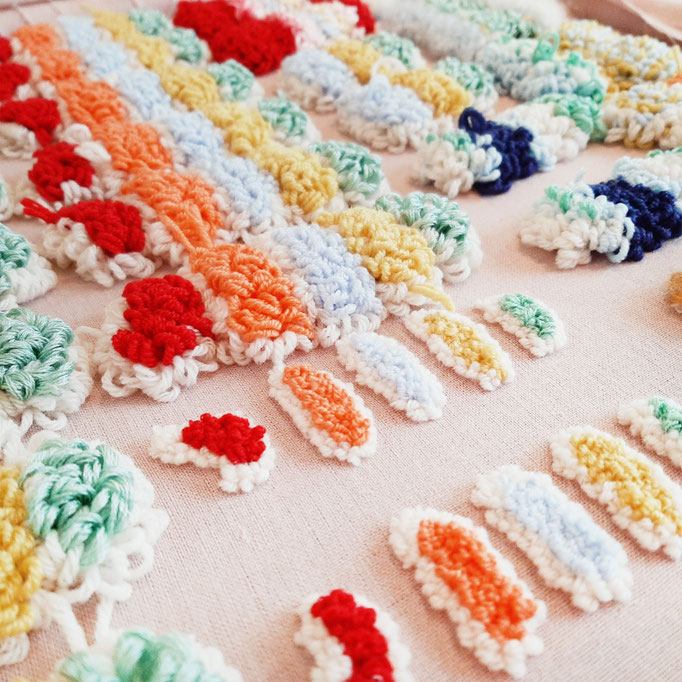


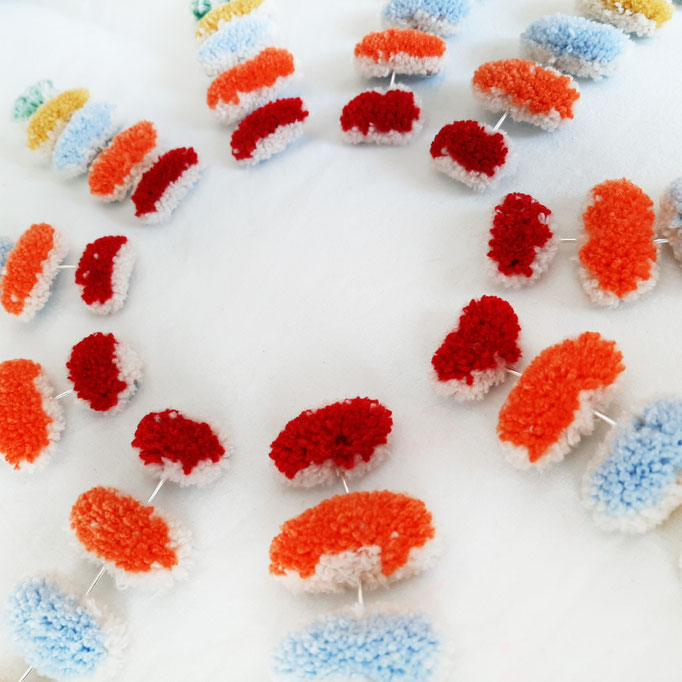

Our Making Process
01 — SELECTING THE FIBERS
The journey begins with carefully selected yarns — silk, alpaca, wool, cotton, and mohair. Each fibre is chosen for its texture, strength, and ability to hold colour beautifully.
02 — HAND TUFTING THE FORM
Using extremely fine needles, delicate yarns are hand-tufted into a textile base. Because the pieces are small and intricate, the process requires patience and precision. Each loop of yarn gradually builds texture, volume, and form.
03 — SHAPING THE DESIGN
As the tufted surface grows, the design begins to emerge. Shapes inspired by nature, colour, and symbolism slowly take form. The yarns are cut carefully and sheared to get the desired tufted look.
04 — HAND EMBROIDERY & DETAILING
Once the structure is complete, hand embroidery adds intricate detailing. Beads, sequins, and threads are stitched carefully into place to enhance depth, colour, and movement.
05 — THOUGHTFUL FINISHING
Each piece is backed with repurposed waste fabrics to provide strength while reducing textile waste. Finally, nickel-free silver-plated brass findings are attached, completing the transformation from fibre to wearable art.
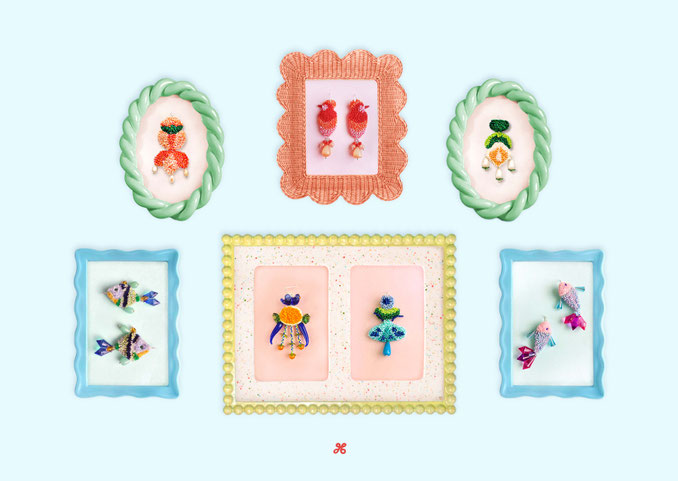
SLOW CRAFT. CONSCIOUS MATERIALS. NO SHORTCUTS.
THE PHILOSOPHY BEHIND IT ALL
Sustainability in jewelry is often talked about in terms of what you don't use. We think about it differently — in terms of what you choose, and why.
We choose yarns that already exist because the world doesn't need more fibre — it needs more imagination applied to what it already has.
We choose handmade beads from artisan communities because supporting living craft traditions is its own form of sustainability — preserving skills, livelihoods, and knowledge that, once lost, cannot be recovered.
We choose recycled glass because we believe beauty has no obligation to be new.
We choose slow making because speed is the enemy of quality, and quality is the enemy of waste. A piece made this carefully, this intentionally, with this much attention, is a piece you keep. A piece that never ends up forgotten at the bottom of a drawer.
This is what sustainability means to us. Not a certification or a marketing claim. A set of daily decisions, made with care, one stitch at a time.
Find your piece. Feel the joy.
Browse the full collection and find the earrings — or necklace, or bracelet — that make you smile the second you see them.